Marshall

Are you the next Marshall Scholar?

The Marshall Scholarship is one of the most prestigious forms of funding for American Masters students in the UK, providing financial support for up to two years (with the possibility in some cases of a third-year extension). Scholarships are available for postgraduate study in any discipline at any British university but candidates are particularly invited to apply for programs at Marshall Partner Universities, which have strong links with the scholarship scheme.

This page will introduce the benefits offered by Marshall Scholarships, as well as explaining how the application criteria and interview process work.
The Marshall Scholarship was established in 1953 by the British government and named after General George C. Marshall, the man who lent his name to the Marshall Plan which distributed economic aid from the USA to Europe in the aftermath of the Second World War.

In the decades since, more than 2,000 Americans students have attended university in the UK with the help of a Marshall Scholarship. Among their number are two US Supreme Court Justices, 14 MacArthur Genius Grant recipients, six Pulitzer winners and one Nobel Prize winner.

There are currently up to 50 Marshall Scholarships available each year, offering the following financial benefits to successful applicants:

  • Tuition fees payment
  • Personal allowance – £1,116 per month (USD $1,465) or £1,369 for London universities (USD $1,800)
  • Travel to and from the UK
  • Grants towards books, as well as your thesis and research expenses
  • Daily travel allowance

In total, the financial value of a Marshall Scholarship is around £38,000 per year (USD $49,945).
The Marshall Commission also has partnerships with a selection of colleges at University of Oxford and the University of Cambridge.

There are a few different pathways you can take during a Marshall Scholarship:

  • One-year Masters scholarship, which can be used to study a one-year Masters and cannot be extended
  • Two-year Masters scholarship, which can be used to study two one-year Master’s program, one two-year research Master’s program or two years of a PhD program
  • Two-year scholarship (with the possibility of a third-year extension), which can be used to combine Masters and PhD study

If you opt for the third option, you can either begin a PhD in the first year or upgrade from a Masters to a PhD, before applying for a third-year funding extension.

In order to fulfil the eligibility criteria for a Marshall Scholarship, you’ll need to:

  • Be an American citizen
  • Have completed a four-year undergraduate degree from an accredited university in the USA by the time of taking up the scholarship
  • Have a GPA of 3.7 during your undergraduate degree
  • Be a ‘recent’ graduate, having graduated no earlier than three and a half years before taking up the scholarship (e.g. April 2020 for September 2023 applicants)

Also, you can’t have previously studied in the UK (whether that’s at university or for secondary education).

Generally speaking, Marshall Scholarships are tenable for most kinds of Masters and PhD program at UK universities. However, there are a few key exceptions in which courses aren’t eligible for funding. These include:

  • MBAs
  • Postgraduate Diplomas and Postgraduate Certificates
  • Distance learning courses
  • Courses that begin in January
  • Courses that involve an international placement

You can see a full list of ineligible courses on the Marshall website.

A Marshall Scholarship can’t be deferred.

Applications for Marshall Scholarships usually open in June, with a deadline for submission at the end of September.

Once you’ve completed your application, it will need to be endorsed by your undergraduate university. Please contact Dr. April Householder to discuss how to obtain the nomination (aprilh@umbc.edu)

Submitting a Short Essay

As part of your application, you’ll need to submit the following short essays:

  • Personal statement
  • Statement about your proposed study plans
  • Statement about your post-scholarship plans
  • Leadership statement
  • Ambassadorial potential statement
Other Documents

You’ll also submit several other documents:

  • Academic transcripts
  • CV
  • Three letters of recommendation (one primary academic, one general academic and one that focuses on your leadership skills)

Academic merit. You’ll need a GPA of at least 3.7 but you should also show evidence of extra-curricular success, through achievements like prizes, publications and scholarships. It’s also important to provide a coherent study plan that shows how your proposed Masters (or PhD) program will help you achieve your academic and career goals.

Leadership potential. This is about showing your influence on others and your track record in delivering valuable results. Evidence of self-awareness, determination, courage and persistence is also important – whether that’s in your studies or as part of your extra-curricular pursuits. Ultimately, you should show that you have a significant capacity to make a contribution to society through your leadership qualities. Strength of purpose and creativity are also important.

Ambassadorial potential. Demonstrable knowledge of US/UK relations is a must, along with evidence of extra-curricular activities that can be put to use in the UK in order to develop those relations. Inter-personal skills, confidence and the ability to engage others around you are other key aspects of this criteria.

The interview itself usually takes around 30 minutes and will be before a selection committee (normally made up of previous Marshall Scholars).

It’s important to tailor your answers to the Marshall Scholarship selection criteria mentioned above – it’s a relatively short interview, so don’t waste your time talking about things that aren’t relevant to the scheme. Avoid generic answers that could easily apply to any other country around the world; make sure you show a meaningful affinity with the UK.

Expect to be asked probing questions about current events – both local and global – as well as the motivations behind your choice of program and institution. It’s a good idea to be clued up on the latest news stories, social trends and cultural movements in the UK. You’ll probably be asked about General George Marshall and the Marshall Plan, so make sure you’ve done your homework!

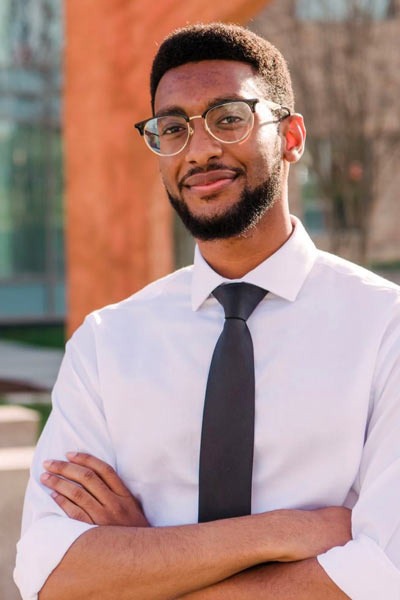
Joshua outside the PAHB

Joshua Slaughter ‘22,

Joshua became the second student in UMBC history and the first in 29 years to be selected for the prestigious award. Slaughter is one 41 American students selected this year from institutions across the country for the Marshall Scholarship, which supports graduate study at institutions in the United Kingdom. He was also a finalist for the Rhodes Scholarship.

Slaughter, who is earning his degree in computer engineering, will pursue his Ph.D. in informatics at the University of Edinburgh. His goal is to advance equity in the developing field of personalized medicine.

Read more at the UMBC News website.

Loren

Loren Siebert , ’93 computer science

When many people have some extra time to spare, they might think about collecting coins, painting model airplanes, or even trying to write the great American novel.

When Loren Siebert ’93, computer science, took up a hobby, though, he decided to learn one of the hardest languages around – Arabic.

The first UMBC graduate to earn the prestigious Marshall Scholarship, Siebert recently developed a software, LinguaStep, that will be used to aid in instruction of the Arabic language programs at over 30 different universities. Indeed, this San Francisco resident has made a very grand entrance into the world of software engineering.

“I’ll always have a constant desire to learn and explore new ideas.”

~ Loren Siebert, ’93 computer science

A Model Student

As a high school student, Loren swam with the Retriever Aquatic Club. He also completed some computer science research with a faculty member at UMBC, thus making early ties with the school.

“To go to UMBC just seemed like a natural extension,” he said. “When I got to UMBC, I knew I was going to be doing computer science, so all that was left was finding other stuff to do.”

Aside from being an excellent student, Siebert competed on the swim team, and worked with the Shriver Center’s Choice Program at UMBC, which provides tutoring and mentoring for at-risk children.

The Big Success

Upon Siebert’s graduation in 1993, he was awarded the competitive Marshall Scholarship to complete his graduate studies in the U.K. Loren earned his master’s in computer science at the University of Manchester and did research on technology policy at the London School of Economics. His master’s research earned him a mention in The Economist and in New Scientist in the same week.

“All of a sudden I went from being a 23-year-old doing computer science research to having all these people in the world wanting to talk to me about how interesting my work was,” he said. “It had a very commercial aspect to it.”

And that’s exactly where his education took him. As a software engineer and entrepreneur for more than a dozen years, Siebert has helped develop a variety of software and web sites, including Quote.com, a site that tracks world financial markets.

The LinguaStep Evolution

After breaking his leg while training for a triathalon, Siebert decided he needed a new hobby to sink his teeth into. He always had an affinity for languages, so he decided that would be a natural route to take. He enrolled at UC Berkeley in 2005 to study the famously difficult language.

“If I’m going to learn a language, I want to learn one of the hard ones,” said Siebert, who said he was, at first, overwhelmed by the language, which shares only 15 characters with English.

He had been researching different techniques used in learning languages, and so developed a software to help himself study. The result was LinguaStep, which focuses on helping students accumulate and retain a large vocabulary, but not waste time re-learning already familiar words. Similar to flash cards, students using LinguaStep can learn at their own pace, and test their knowledge of vocabulary as they need it. As students prove they have learned certain words, the software removes those words from the testing cycle.

Within a year, Siebert received an offer from UC Berkeley to teach an Arabic class, however he left after two semesters to work full time on LinguaStep. The software officially launched in fall 2007, and already more than 30 universities have contacted Siebert with interest in using his software in their Arabic language programs. He is currently planning on designing LinguaStep for other languages – including Mandarin, Korean and Japanese – to address a wider population.

“I want to see how far I can take it,” he said. “I’m a really curious person, and I think that’s something that was instilled in me at UMBC. I’ll always have a constant desire to learn and explore new ideas.”

– Melissa Gilden ’10
Originally posted March 2008